

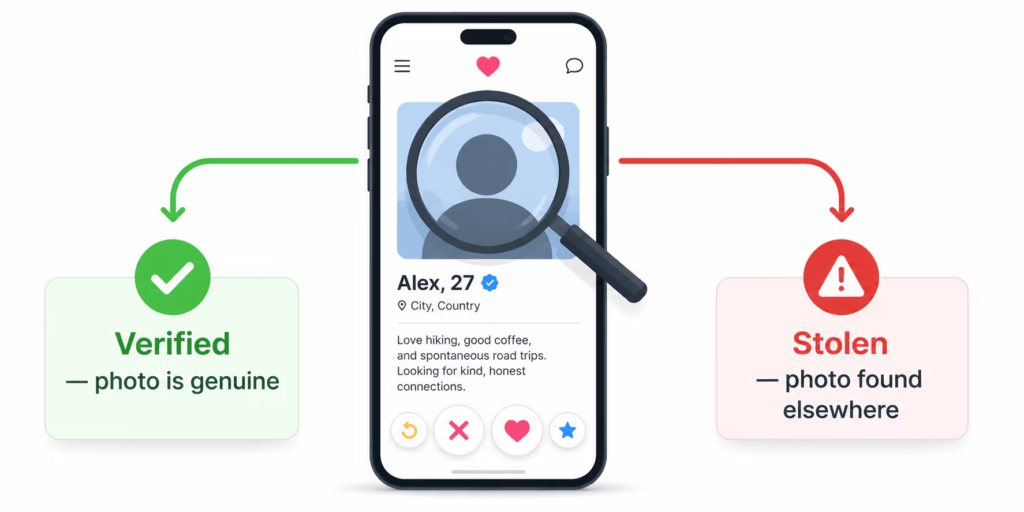
Why Dating Profiles May Need Extra Verification
Online dating has changed the way people meet and form relationships. With a few taps, users can discover potential matches, exchange messages, and develop connections with people they may never have encountered offline. Although most dating profiles are created honestly, the digital nature of these interactions can make it difficult to know whether every detail is accurate.
Some users may rely on outdated photographs, while others may exaggerate information about their lifestyle, career, or background. More concerning situations involve stolen profile pictures, impersonation, catfishing, and fake identities created to manipulate other people.
Because a dating profile only presents the information someone chooses to share, additional verification can sometimes be useful. A Facebook reverse image search can provide another way to investigate a profile photograph and look for potential connections across supported social-media platforms.
Face2social supports profile-photo analysis across Facebook, Instagram, X, and TikTok, allowing users to gather additional context when evaluating an online identity.
The Profile Photo as a Verification Clue
A photograph can sometimes provide information that is difficult to obtain from a name or username. People frequently reuse the same profile image on multiple social-media accounts, particularly when they want their online presence to look consistent.
This makes a profile photo a potentially useful starting point for a visual investigation. If the same image appears elsewhere, users can compare the associated information with what they already know about their online match.
A matching photograph is not automatically suspicious. Someone may simply be using their own image across several accounts.
The value comes from comparing the complete context rather than focusing on the image alone.
How Face2social Can Help Investigate Photos
Face2social is designed for profile-photo analysis across Facebook, Instagram, X, and TikTok. Users can investigate a profile photograph and consider potential matches across these supported social-media platforms.
For example, imagine that you have been communicating with someone through a dating app. Their profile appears attractive and convincing, but you want to gather more information before becoming deeply involved.
You can use their profile photo as a starting point for investigation. Potential social-media matches can then be compared with the name, location, interests, and other information provided by the person.
This approach does not replace communication or personal judgment. Instead, it gives users another source of information to consider.
Checking Whether a Photograph Has Been Reused
One important reason to investigate a dating photograph is the possibility that it has been reused elsewhere.
Genuine users commonly reuse their own photographs across social-media platforms. This is normal and may even help establish consistency between profiles.
However, fake dating accounts can also use photographs copied from real people. A scammer may take an attractive image from a public social-media profile and place it on a dating account under a different name.
If a potential match appears with conflicting identity information, examine the situation carefully. Compare the photograph, names, and other available profile details.
A Facebook reverse image search can help provide the initial clue, while the surrounding information helps determine what that clue actually means.
Recognizing Potential Catfishing
Catfishing occurs when someone presents a false or misleading identity online. In dating situations, a catfish may use another person’s photograph and invent details about their life.
The problem can be difficult to recognize because the person may communicate frequently and appear emotionally invested. They may share personal stories, discuss future plans, and create a strong sense of connection.
A visual profile check can sometimes reveal information that deserves further attention. If the photograph appears associated with another identity, it may be sensible to slow down and ask questions.
Searching alone does not prove that someone is catfishing. It is better to treat the result as one piece of evidence in a larger verification process.
Identifying Outdated Profile Pictures
Some dating profiles are misleading without being deliberately fraudulent. A user may simply use an old photograph that no longer represents their current appearance.
This can become relevant before an in-person date. If someone expects to meet the person shown in a recent-looking photograph, discovering that the image is several years old may create an uncomfortable situation.
Examining other profile photographs can sometimes provide additional context about the age of an image.
The purpose is not to judge someone’s appearance. Instead, it is to help ensure that both people have realistic expectations before meeting.
Comparing Information Across Social Media
A visual match becomes more meaningful when combined with other profile information.
Compare names, locations, occupations, interests, and other details that are publicly available. If several profiles associated with the same photograph contain generally consistent information, that may provide additional reassurance.
On the other hand, several major contradictions can justify asking further questions.
For example, an online match may say they live in one city while another profile associated with their photograph repeatedly identifies a different location. This could have an innocent explanation because people move and old accounts may remain unchanged.
For this reason, individual differences should be interpreted carefully. Look for patterns rather than treating every discrepancy as proof of deception.
Understanding Romance Scam Warning Signs
Dating profile checks can be particularly valuable because romance scams often depend on false identities.
A scammer may spend considerable time developing an emotional relationship before introducing a financial request. They may claim to need money for travel, medical expenses, family emergencies, or other urgent situations.
Never provide money or sensitive banking information to someone simply because you have developed feelings for them online.
If suspicious profile information is combined with financial pressure, refusal to answer basic questions, or rapidly increasing emotional demands, it may be time to reconsider the relationship.
A visual search is not a complete scam-detection system, but it can contribute to a broader approach to online safety.
What to Do When a Search Produces a Different Identity
Finding a possible match with a different name can be concerning. However, the first response should be careful investigation rather than immediate accusation.
Check whether the photographs are genuinely the same. Consider whether the potential profile might be old or whether the person could legitimately use another name online.
If appropriate, ask the person about the difference. A genuine explanation may resolve the issue.
Pay attention to their response. Someone who answers clearly may simply have an old account or another reasonable explanation. Someone who repeatedly changes their story or pressures you to stop asking questions may give you a reason to step back.
You are never required to continue communicating with someone when you feel uncomfortable.
Know the Limitations of Image Searching
A Facebook reverse image search can provide useful clues, but it should not be treated as conclusive identity verification.
A potential visual match does not automatically prove that two profiles belong to the same person. People may legitimately use the same photograph on different accounts, and similar-looking people can sometimes produce confusing results.
Likewise, no match does not prove that a dating account is genuine.
Face2social should therefore be viewed as a supporting resource. Its results should be considered alongside direct communication, profile consistency, video calls, and other reasonable verification methods.
Protect Yourself Before Meeting
Profile checks are only one part of safer online dating. Before meeting someone for the first time, consider having a video call. This can provide another opportunity to confirm that the person matches their profile.
Choose a public location for your first meeting and tell someone you trust about your plans. Maintain control over your transportation and avoid sharing unnecessary personal information.
Protect your digital privacy as well. Do not provide passwords, financial details, identification documents, or your exact home address to someone you have only recently met online.
If an online match pressures you to ignore your concerns or move faster than you are comfortable with, you can always slow down.
Let Verification Support Natural Trust
Verification should not replace genuine communication. Instead, it can help create a more informed foundation for trust.
A person who is honest about their identity should generally understand why someone may want to confirm basic information before meeting. Respect for boundaries and willingness to communicate openly are valuable signs in any developing relationship.
Using Face2social as part of this process can provide additional context from profile photographs across Facebook, Instagram, X, and TikTok.
The objective is not to assume that everyone online is suspicious. It is to give yourself enough information to make comfortable decisions.
Conclusion: A Useful Addition to Profile Checks
Dating profiles can provide an introduction to a potential relationship, but they do not always tell the complete story. Stolen photographs, outdated images, catfishing, impersonation, and romance scams can make online identity verification important.
A Facebook reverse image search can support dating profile checks by providing another way to investigate a profile photograph and look for potential social-media connections. Face2social analyzes profile photos across Facebook, Instagram, X, and TikTok, giving users additional information to compare with the details presented by an online match.
The results should always be interpreted responsibly. A potential match is a clue rather than definitive proof, while the absence of a match does not guarantee authenticity.
Combining visual investigation with consistent communication, video calls, financial boundaries, privacy protection, and safe meeting practices can provide a more balanced approach to online dating. Taking time to verify information before placing significant trust in an online match can help users recognize potential warning signs and make more informed decisions.